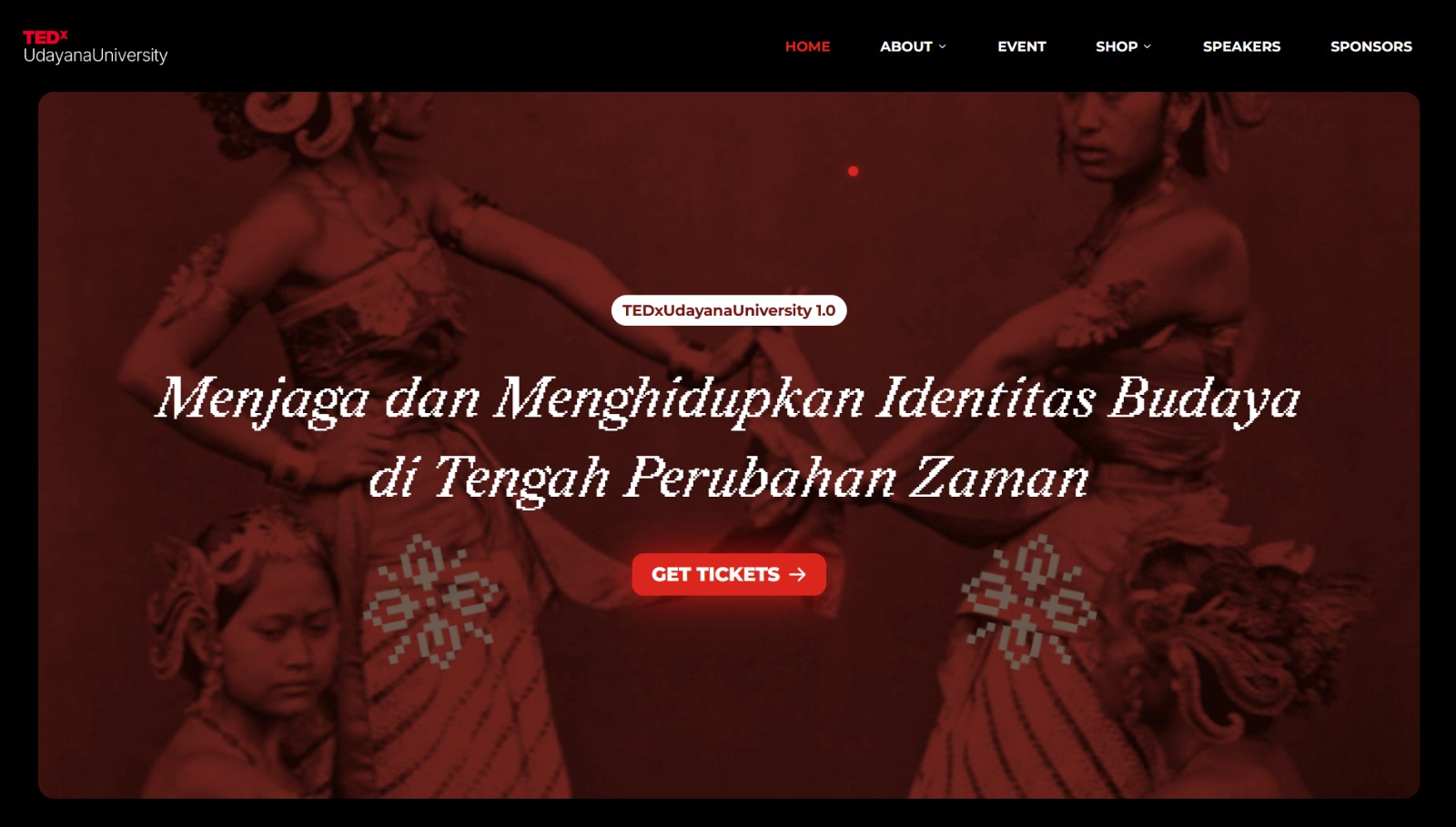
On September 26, 2026, five minutes before check-in at the TEDxUdayanaUniversity main event, we found several orders with the same seat number.
In five minutes, people would start showing up with e-tickets that told them exactly where they were supposed to sit. Our system had given some of them the same answer.
I remembered something I’d said at an all-staff meeting before the event. We were testing the seat picker and needed to use a real seat.
We can just delete it later.
I’d been very confident about the word just.
01. The Instagram DM
On November 15, 2025, someone sent me an Instagram DM and introduced themselves as a co-executive at TEDxUdayana. Udayana had never hosted a TEDx event before, they said. The team had secured an official license and was putting together the first edition.
They’d heard about my experience with websites and IT. TEDx required the organizers to have an official website, and they asked if I wanted to join as Website Coordinator.
Of course I said yes. It was TEDx.
I understood the website part. The part I had to figure out was how to start a Website/IT division for an event that had never happened on our campus. There was no previous edition to look back on. The rest of the committee was figuring out their own version of the same thing.
For the first four months, the team consisted of the executive board and the directors. Staff recruitment was still ahead of us, and most of that time went into working out the basics of the event. I took the executives’ brief and made a preview of the website so we had something we could actually look at.
I remember being pretty impressed with myself. I thought it looked cool. Looking at it now, I have no idea what I was seeing.
Still, I’m glad I made it. A preview gave us something specific to talk about. We could look at a page together and decide what belonged there. Before that, everybody could agree we needed a website and still be picturing a completely different one.
02. The division was three people, including me
Staff recruitment opened toward the end of those first four months. Nobody applied to Website/IT.
I’d expected it might happen. It still felt different when it actually happened and I had to figure out who was going to help me build the thing. I reached out to a few friends, and in the end two of them joined. That was the entire division.
I led the project and worked on the frontend. D handled the backend. A took care of UI/UX and also worked on the frontend. With three people, those titles were mostly a way to make sure everybody knew where to start. The site still had to come together across all three of our jobs.
We spent the next stretch planning how it would work and dividing up the tasks. We also got to speak with teams from TEDxITB, TEDxITS, and TEDxUNAIR during an internal capacity-building session. They shared what they’d learned from running their own events and gave us feedback on the website. For a team building its first edition, it was a relief to talk to people who could tell us what they’d run into once their sites were actually in use.
Things felt manageable at that point. I could look at the list of features, see who was working on what, and imagine all of it getting done.
The detail I gave too little thought to was that D, A, and I were in the same year at university. All three of us had sempro, our thesis proposal defenses, coming up. All three of us also had KKN, our university community service program. On the project plan, we were three people who could share the workload. On the academic calendar, we were three people about to get busy at the same time.
03. A website with two pages and a lot of “coming soon”
The site launched on May 14, 2026. You could visit the homepage and read about the event. If you wanted tickets or merchandise, you got coming soon.
The pre-event was scheduled for June 6, and our checkout was still unfinished. We discussed it with the Merchandise and Ticketing division and the executive board. What did people actually need from the site by June 6? They needed to see the available tickets and have a way to buy them. So we’d publish a ticket page and send buyers to a Google Form to complete their purchase.
I’d spent a lot of time thinking about what checkout should look like on our site. In that meeting, we had to think about what the ticketing team could run on the day. The Google Form gave us a way to sell tickets with the time we had. We later made the same call for merchandise. Every hour we spent building a second checkout was an hour we couldn’t spend finishing the first.
After the pre-event came sempro, and after sempro came KKN. My placement had barely any signal. The university had also shortened KKN to 28 days, so I was trying to fit community projects, team coordination, and website development into that window.
We still hadn’t finished ticketing.
I started getting stricter about what we could realistically finish and when. It was one thing to put a task on the list with someone’s name next to it. It was another to account for when that person would actually have time to sit down and work on it. At that point, I was the one trying to coordinate from a place where getting a decent signal was already a task of its own.
04. Getting main-event tickets out the door
We eventually finished checkout on the site. The idea was that buying a ticket should feel a bit like booking a seat at the cinema. Pick a ticket type, choose how many you want, enter your details, select your seats, and pay.
We went with QRIS because of the requirements and paperwork involved in setting up a payment gateway. We used our static QRIS code to generate a payment QR with the amount for each order. QRIS converter
Payment confirmation was manual. After paying, the buyer uploaded proof of payment, and their order went into a pending state. Someone from Merchandise and Ticketing would review the proof and approve the order. Approval triggered an email with the e-ticket. The buyer could then bring that e-ticket to the main event, where the committee would scan it and exchange it for a physical ticket.
By then, “buy a ticket” meant a series of handoffs. A buyer was trusting that the seat they picked would be theirs. The ticketing team was trusting that an approval would send the right email. At check-in, someone would be looking at the ticket our system had issued and matching it to what was happening in the room. All of those people had to be working from the same information.
We fixed a few payment bugs, and for a while I felt like we’d finally caught up.
05. The laptop I left at home
Before the main event, there was an all-staff meeting. I left my laptop at home. It was heavy, and I’d gone there expecting a meeting. Then the three of us ended up sitting together, talking through bugs, and deciding to test the seat picker.
The laptop we had with us still needed a local environment. We’d also left unit tests out of the project, so there was nothing we could run quickly to check what we wanted to check. We tested in production.
We picked an empty seat and made a real transaction. Everything went through. Then we tried to make the seat available again.
That was when we remembered how we’d designed the system. Once an order was approved, it was meant to be immutable. The test order had gone through the real checkout, so as far as the system was concerned, somebody had bought that seat. It was doing exactly what we’d built it to do.
Our next decision was to loosen the safeguard for a bit.
We forgot to turn it back on.
By the time we found the duplicate seat numbers, check-in was about to start. The only workable option we could come up with in those five minutes was to ask the people who’d booked later if they’d be willing to move. Merchandise and Ticketing would have to explain that in person.
That’s the part I keep coming back to. When I said we could delete the test order later, I was thinking about one seat on a screen. At check-in, a colleague had to talk to someone who’d paid for that seat, picked it themselves, and had an e-ticket that gave them every reason to expect it would be theirs.
06. How I’d start the year now
I’m proud of what we built. Three students got an official website online, built the ticketing system for a first edition, and figured out a lot of things as we went. The positive feedback from the committee meant a lot to me. I’m grateful to D and A for doing this alongside everything they had going on at university, and to Merchandise and Ticketing for handling what we handed them at the door.
This was my first time working in a team on a project that big. It was also my first time directing one. I came in knowing how to build websites and spent the year learning what it takes to give other people the time, information, and setup they need to do their work.
If I could go back to the start, I’d sit down with D and A and put our academic deadlines on the same calendar as the event. I’d separate the website is live from the website can sell tickets and give each milestone its own deadline. I’d also set aside time early for all three of us to run the project locally and test the rules that matter most. One seat per booking would be high on that list.
And if we ever had to relax a production safeguard again, I’d make sure somebody owned the job of turning it back on before we moved on to the next thing.
I’d probably still leave my laptop at home for an all-staff meeting. The next time someone says, “While we’re all here, let’s test this real quick,” I want us to have somewhere safe to do it.